

If every school morning has become a battle involving tears, stomach aches, pleading, or emotional shutdown, your child may be experiencing school refusal.
Many families in Mississauga and across Peel Region struggle with school-related anxiety, but parents are often unsure whether to insist on attendance, offer reassurance, or seek professional help.
School refusal is usually a sign that something is making school feel emotionally or physically unmanageable, not a sign that you have failed as a parent.
What Is School Refusal?
School refusal is not the same as a child occasionally not wanting to go to school. It is a persistent pattern of distress that makes attending school genuinely difficult, often despite a parent’s best efforts to encourage, reassure, or insist.
It is not defiance for the sake of it. In most cases, school refusal is a sign that a child is struggling emotionally in a way that has not yet been fully understood or addressed.
Signs Your Child May Be Experiencing School Refusal
Crying Every Morning
When tears become a daily routine rather than an occasional reaction, something deeper is usually going on. Persistent morning distress that resets every school day is one of the clearest signs that a child is not simply adjusting.
Stomach Aches and Physical Complaints
Headaches, nausea, and stomach pain that appear every school morning but disappear on weekends are not always made up. The body responds to emotional distress in real, physical ways. Our article on what anxiety is and its types explains this connection in more detail.
Panic Before School
Some children experience genuine panic responses that may lead up to school. Racing heart, difficulty breathing, or feeling frozen are signs of real physiological distress, not manipulation.
Emotional Shutdown
Not all school refusal looks loud. Some children go quiet, withdraw completely, or become unreachable emotionally in the mornings. This kind of shutdown is just as significant as more visible distress and is often easier to miss.
Why Children Refuse School
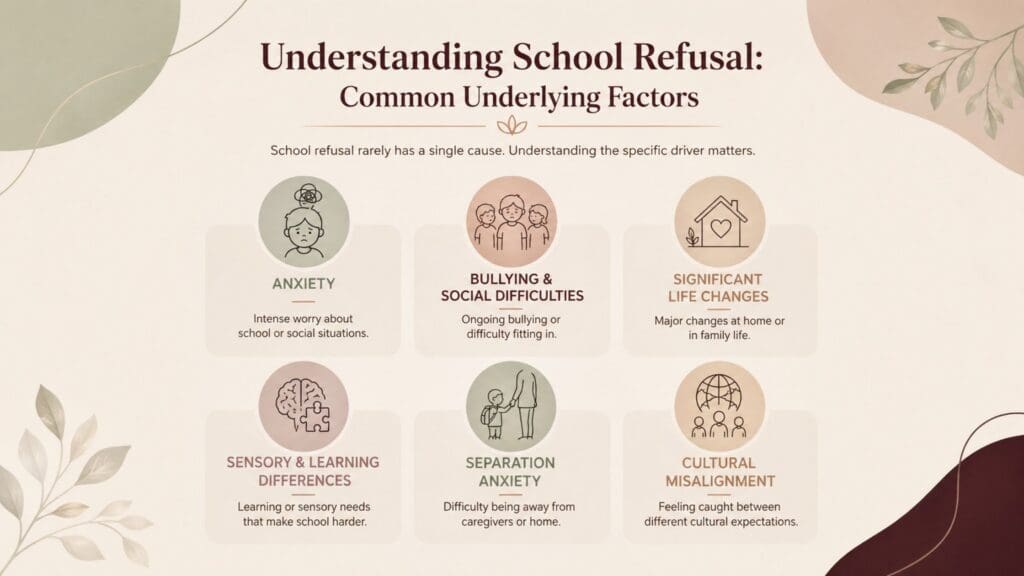
School refusal rarely has a single cause. Common underlying factors include:
- Anxiety about academic performance, social situations, or a specific teacher or peer
- Bullying or social difficulties that have not been disclosed to parents
- A significant life change such as moving, divorce, or a new sibling
- Sensory or learning differences that make the school environment overwhelming
- Separation anxiety, particularly in younger children
- For children from immigrant or BIPOC families, feeling caught between two worlds at school and home
Understanding the specific driver matters because the right response looks different depending on the cause. Our article on back-to-school anxiety explores some of these triggers in more depth.
What Makes School Refusal Worse
The instinct to push harder, set firmer consequences, or punish a child for not attending school is understandable. But with school refusal, pressure and punishment almost always increase fear rather than reduce it.
When a child is already in a state of genuine distress, adding consequences communicates that their feelings are not valid, which deepens the emotional response rather than resolving it. It can also damage the parent-child relationship at a time when that connection is one of the most important tools available.
Inconsistency also makes things worse. Allowing a child to stay home some days but not others send a mixed signal that reinforces the pattern rather than breaking it.
What Actually Helps
Validation
Before anything else, a child needs to feel that their experience is taken seriously. Saying “I can see this feels really hard for you” without immediately trying to fix or dismiss the feeling creates the emotional safety that makes everything else possible.
Gradual Exposure
Forcing a full return to school in one step rarely works for a child in genuine distress. A gradual, supported approach, starting with shorter days, a trusted adult at school, or a specific comfort routine, helps rebuild a sense of safety over time.
Emotional Coaching
Helping a child name and understand what they are feeling gives them tools to manage it. Children who can identify their emotions are better equipped to move through them rather than being overwhelmed by them. Our article on why your brain freezes during exams touches on how the stress response affects children in school settings.
Consistent Routines
Predictability is calming for anxious children. A consistent morning routine that is calm, warm, and time-limited reduces the space for anxiety to build before school.
When to Seek Professional Support
If school refusal has been going on for more than a few weeks, is escalating, or is affecting your child’s overall wellbeing and your family’s daily functioning, it is time to bring in professional support.
This is not a sign that you have done something wrong. School refusal often needs more than parental reassurance to resolve, particularly when anxiety, trauma, or learning differences are part of the picture.
Our child therapy and teen and student therapy services at Inner Voice Therapy in Mississauga work directly with children and teenagers experiencing school refusal, anxiety, and emotional dysregulation.
According to the Canadian Psychological Association, early intervention for school refusal leads to significantly better outcomes than allowing the pattern to continue untreated. The longer school refusal persists, the harder it typically becomes to address.
Get Help With School Refusal in Mississauga
If your child’s school refusal is affecting attendance, family relationships, or your ability to manage daily life, you do not have to wait for the situation to become more severe.
Sarah Ali at Inner Voice Therapy offers culturally responsive child therapy and parent coaching in Mississauga for school refusal, separation anxiety, emotional outbursts, and school-related distress.
Contact Inner Voice Therapy today to book a consultation and determine whether child therapy, parent coaching, or a combination of both would best support your family.
Conclusion
School refusal is exhausting, worrying, and often isolating for parents. But it is also something that responds well to the right support. Understanding what is driving your child’s distress, responding with validation rather than pressure, and building consistent routines are all meaningful steps in the right direction.