When anxiety makes your chest tight, or depression makes getting out of bed feel impossible, you know something needs to change.
You’ve likely heard therapy can help, but when you search for a therapist in Mississauga or Ontario, the prices make your heart sink. Sessions ranging from $160 to $250 feel out of reach, especially when you’re already struggling.
You’re not alone in this frustration. Recent data shows that one in five Canadians experiences a mental health condition each year, yet cost prevents 15% of Canadians from accessing the mental health services they need.
That figure jumps dramatically for young adults, with 57% of people aged 18-24 reporting that cost is a barrier to getting help.
Here’s what many people don’t realise: believing you can’t afford therapy doesn’t mean you’re stuck suffering in silence.
Multiple low-cost and even no-cost options exist in Ontario, specifically designed for people facing financial barriers. This article will walk you through why therapy costs what it does, then show you practical ways to access affordable mental health care in Mississauga and across Ontario.
Why Therapy Seems So Expensive
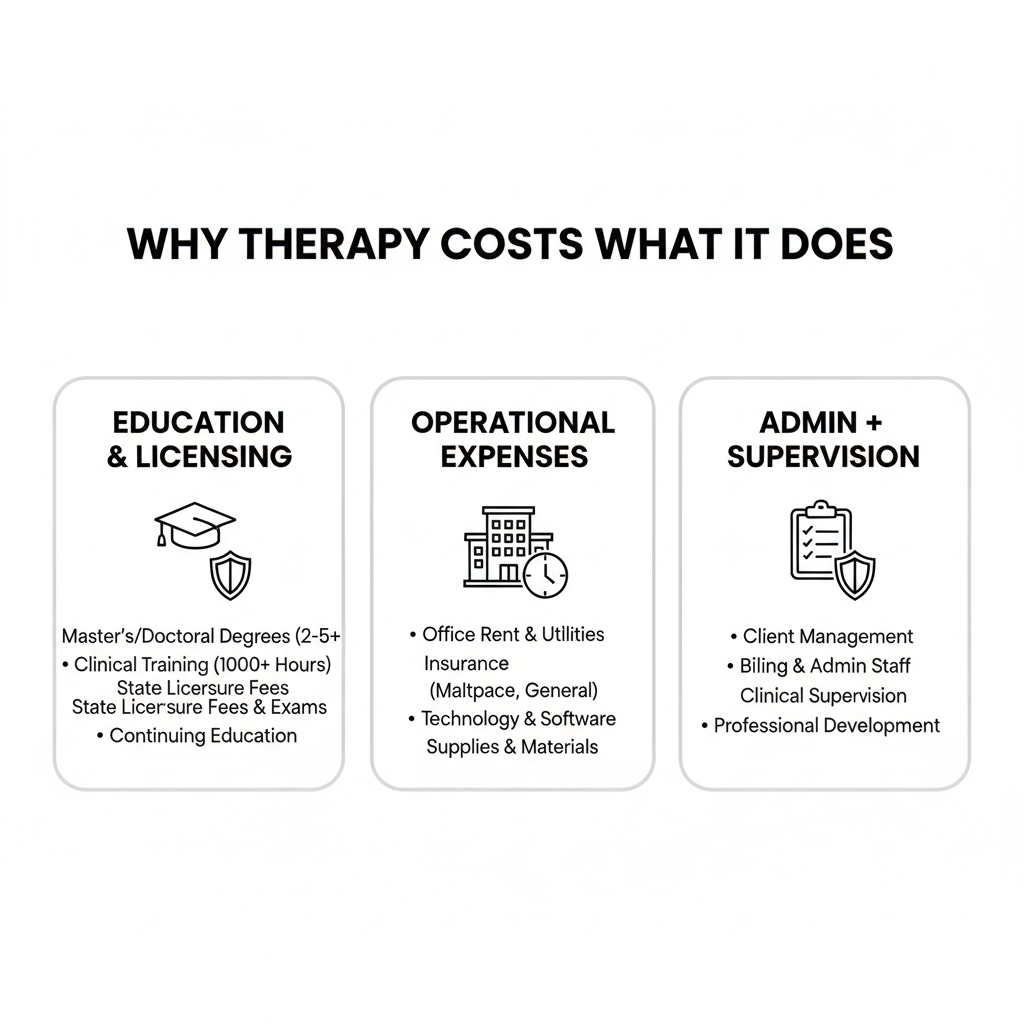
Understanding why therapy sessions cost $160, $200, or even $250 helps explain what you’re actually paying for. The price isn’t arbitrary.
Education and Licensing Costs
Therapists complete extensive education before they can practice. Most hold master’s degrees in Counselling Psychology or Social Work, requiring 6-7 years of university education.
Psychologists need even more, completing doctoral programs that can take 8-10 years. This education doesn’t come cheap. Student loans for graduate programs in Ontario often exceed $40,000-$60,000, and therapists spend years repaying this debt while building their practices.
After graduation, therapists must complete hundreds of supervised clinical hours before they can practice independently.
In Ontario, Registered Psychotherapists need 450 hours of direct client contact under supervision. This supervised period means working for reduced rates or even volunteering while gaining experience.
Operational Expenses and Hidden Costs
When you pay $175 for a therapy session, your therapist doesn’t pocket that entire amount. Running a private practice comes with substantial overhead.
Office rent in Mississauga averages $1,500-$3,000 monthly for professional space. Liability insurance, required for all practitioners, costs $2,000-$5,000 annually.
Add professional association fees, continuing education requirements (often $3,000+ yearly), electronic health record systems, secure communication platforms, and administrative software, and the costs add up quickly.
Therapists also handle unpaid administrative work: documentation, treatment planning, insurance paperwork, scheduling, and professional development. For every hour spent with clients, therapists typically spend 15-30 minutes on related administrative tasks.
The Emotional Labour Factor
Therapy isn’t just a job; it’s emotionally demanding work. Therapists hold space for intense pain, trauma, and distress hour after hour.
This requires their own ongoing therapy, clinical supervision (which costs $100-$200 per session), and regular self-care practices to prevent burnout and maintain the quality of care you deserve.
Supply, Demand, and the Value Proposition
Ontario faces a critical shortage of mental health professionals. With wait times for community mental health counselling averaging 67 days in Ontario, and demand far exceeding supply, therapists can maintain higher rates.
But here’s the important part: effective therapy changes lives. Research consistently shows that therapy improves relationships, work satisfaction, physical health, and overall quality of life. The investment often pays for itself through better career performance, fewer medical visits, and improved relationships.
What If You Need Therapy But It Is Too Expensive?
This question keeps many people suffering longer than necessary. Financial barriers are real, but they’re not insurmountable. The key is knowing where to look and what resources exist specifically for people in your situation.
Ontario offers more affordable therapy options than most people realise. Some programs charge as little as $40-$80 per session. Others operate on sliding scales based on your income.
Still others provide completely free services. The following sections break down exactly where to find these resources and how to access them.
Understanding Insurance Coverage in Ontario
Before exploring low-cost options, check if you already have coverage you’re not using.
What OHIP Covers (and Doesn’t)
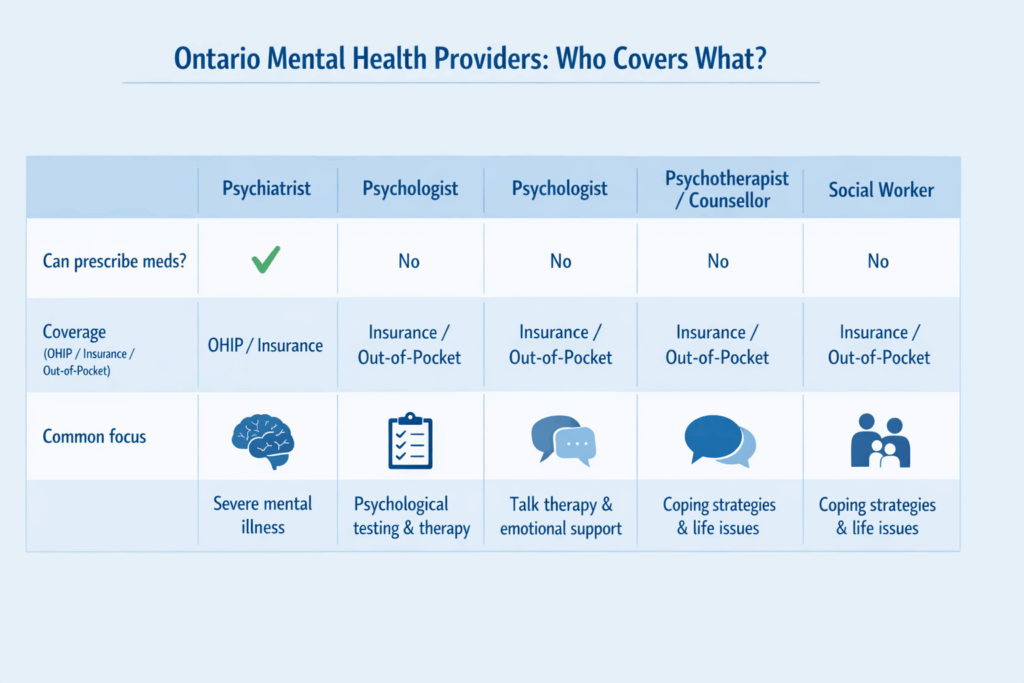
Ontario’s public health insurance (OHIP) covers visits to psychiatrists and medical doctors who provide psychotherapy. These services are completely free if you have a valid Ontario health card.
The catch? Wait times for psychiatrists often stretch 3-6 months or longer, and they typically focus on medication management and diagnostic assessments rather than ongoing talk therapy.
OHIP does not cover services from psychologists, psychotherapists, social workers, or counsellors in private practice. This creates a gap where many people need immediate help but can’t access OHIP-covered services quickly enough.
Psychiatrists vs. Psychologists vs. Psychotherapists vs. Social Workers
Understanding the differences between mental‑health professionals helps you understand coverage:
| Professional | Education & Role | Coverage & Prescription |
| Psychiatrist | Medical doctor with specialty in psychiatry; can diagnose and prescribe medications. Often treats complex or severe mental illnesses. | Covered by OHIP when accessed through a physician referral. |
| Psychologist | Doctoral degree (PhD or PsyD) in psychology; trained in assessment, diagnosis and evidence‑based treatments. | Not typically covered by OHIP; often reimbursed by private insurance. Cannot prescribe medication. |
| Psychotherapist / Counsellor | Master’s degree (e.g., counselling psychology, psychotherapy or social work) and supervised practicum; provides talk therapy for anxiety, depression, trauma and everyday stressors. | Not covered by OHIP; may be covered by extended health benefits or paid out of pocket. Cannot prescribe. |
| Social Worker | Bachelor’s or master’s degree in social work; offers counselling and connects clients to community resources. | In private practice, sessions are not covered by OHIP but may be reimbursed through insurance. |
Private Insurance and Extended Health Benefits
If you have a job with benefits or purchase private insurance, you likely have some mental health coverage. Major insurers like Sun Life, Canada Life, Manulife, and Great-West Life typically include $500-$3,000 in annual coverage for psychological services.
Here’s how to maximise your insurance benefits:
Review your policy details carefully. Look for coverage under “Paramedical Services,” “Mental Health Services,” or “Psychological Services.” Note your annual maximum, per-session limit, and whether you need pre-authorisation.
Check provider eligibility. Some plans only cover psychologists (PhD or PsyD) while others include Registered Psychotherapists (RP), Registered Social Workers (RSW), and Master’s-level counsellors. At Inner Voice Therapy, our team includes various qualified professionals, so we can often work within your specific coverage requirements.
Keep detailed receipts. Insurance companies require official receipts with the provider’s name, registration number, date of service, and amount paid. Keep these organised for easy submission.
Submit claims promptly. Most insurers require claims within 12 months of service. Don’t let reimbursements expire by waiting too long.
Combine benefits strategically. If you and your partner both have insurance, you might combine coverage to increase your total available funds. Some families can access $4,000-$6,000 this way.
Where to Find Affordable Therapy in Ontario
Sliding-Scale and Reduced-Fee Therapy
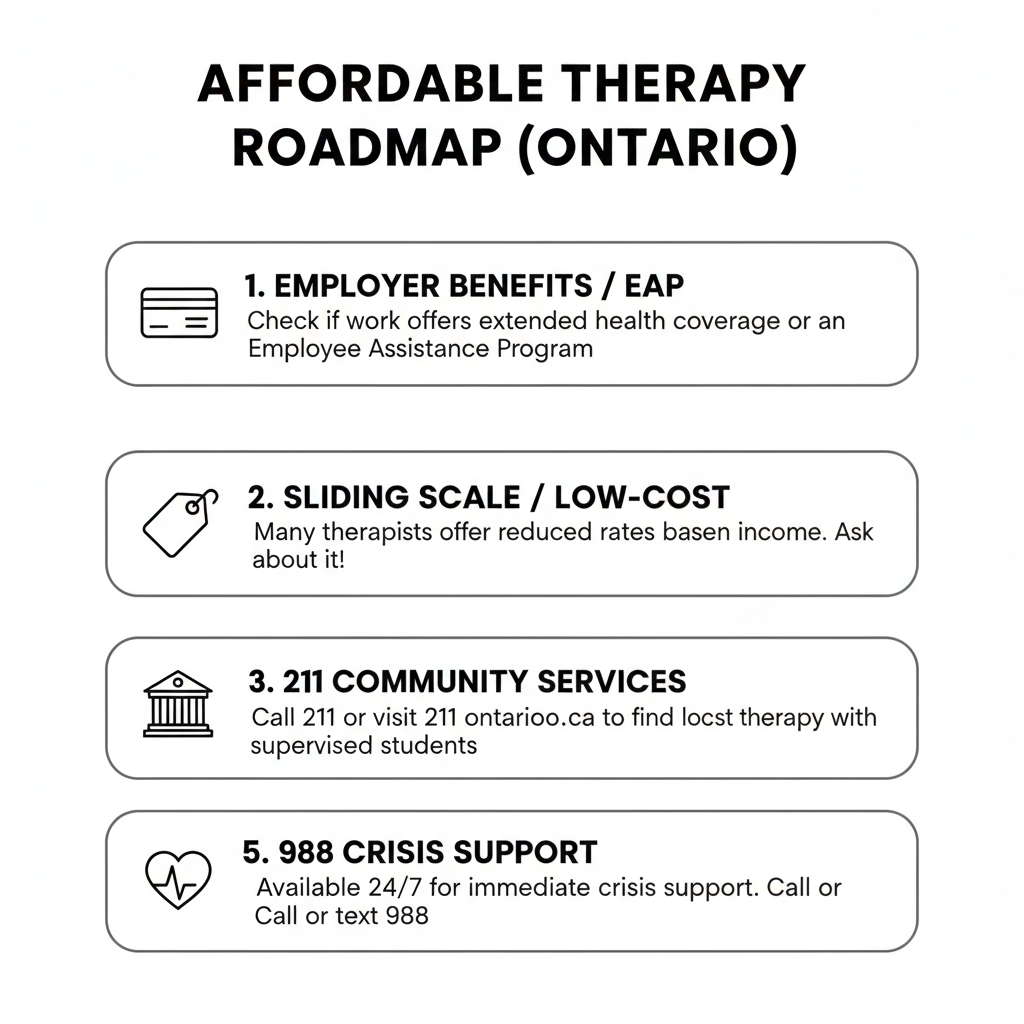
Sliding-scale therapy adjusts fees based on your income and financial situation. Instead of one fixed rate, therapists offer a range, charging less for those with limited means and more for those who can afford it.
When searching for sliding-scale therapy, try these strategies: Search “sliding scale therapy [your city]” or “affordable therapy [your city].”
Contact therapists directly and ask if they offer reduced rates for people with limited income. Many therapists keep a few sliding-scale slots available but don’t advertise them publicly.
Be honest about your financial situation. Most therapists entered this field because they genuinely want to help people, and many will work with you if they can.
Training Clinics and Student Therapists
Universities and training institutes operate clinics where student therapists provide services under close supervision. These sessions cost significantly less than private practice rates, typically $40-$80 per session.
Don’t let the word “student” worry you. These therapists are completing graduate degrees in counselling or psychotherapy.
They’ve completed years of coursework and are working toward their clinical hours requirement under licensed supervisors who review every case. Many clients find student therapists especially dedicated and current on the latest research.
At Inner Voice Therapy, our affordable therapy program follows this model. We offer virtual sessions with student intern therapists completing Master’s degrees in Counselling Psychology or Social Work.
These interns are supervised by Dr Natasha Ramzan and her team of licensed clinicians, ensuring you receive professional, quality care at accessible rates.
This program specifically serves individuals facing financial barriers, students, seniors, low-income families, and anyone who needs flexible, affordable care in a judgment-free environment.
Community Health and Mental Health Centres
Community Health Centres (CHCs) across Ontario offer counselling and mental health services on a sliding-scale basis or completely free, depending on your income.
These centres use an integrated care model, combining mental health support with primary medical care, social services, and health promotion programs.
To find CHCs and community mental health services in your area, call 211 or visit 211.ca. This free, confidential service connects Ontario residents with local community and social services.
Simply tell them you’re looking for affordable mental health support, and they’ll provide options based on your location and needs.
These centres often have wait lists, so get your name on the list while you explore other immediate options.
Employee Assistance Programs (EAPs)
If you’re employed, check whether your company offers an Employee Assistance Program. EAPs provide confidential short-term counselling paid for by your employer, typically 3-8 sessions per issue per year, completely free to you.
Contact your HR department and ask about EAP services. These programs are confidential; your employer won’t know you’re using them. Many EAPs also offer 24/7 crisis support, work-life balance resources, and referrals for longer-term care if needed.
Some companies also offer mental health days, wellness stipends, or health spending accounts that can cover therapy costs.
School and University Counselling Services
If you’re a student, take advantage of campus counselling services. Most colleges and universities in Ontario offer free or very low-cost therapy to enrolled students.
Services typically include individual counselling, group therapy, workshops, and crisis support.
Contact your school’s wellness centre, student health services, or counselling department. Many institutions now offer virtual sessions, making access easier if you’re off-campus or balancing work and school.
Student health insurance plans also often cover additional therapy beyond campus services. Check your student insurance policy for mental health coverage amounts.
Online Therapy Platforms and Mental Health Apps
Online therapy has become increasingly accessible and affordable. Platforms like BetterHelp and Talkspace offer subscription models that can be less expensive than traditional in-person therapy, with sessions sometimes costing $60-$90 per week for unlimited messaging plus live sessions.
Virtual therapy removes barriers like transportation costs and time off work. Research shows online therapy is equally effective as in-person sessions for conditions like anxiety and depression.
Some platforms accept insurance, which can reduce your out-of-pocket costs further. Check with the platform about insurance acceptance before signing up.
Self-help apps provide additional support between therapy sessions or when you’re waiting to access care:
MindShift CBT (free, developed by Anxiety Canada) teaches cognitive behavioural therapy strategies for managing anxiety.
Headspace and Calm offer guided meditation and mindfulness exercises to manage stress.
BounceBack Ontario provides a free, guided self-help program with workbooks and telephone coaching for people 15 and over dealing with depression, anxiety, or stress.
If you’re in Mississauga or anywhere in Ontario and looking for affordable, quality virtual therapy, visit our affordable therapy page to learn about our program and book a free consultation.
We understand the challenges of anxiety and depression, and we’ve designed our program specifically so cost doesn’t prevent you from getting support.
Support Groups and Self-Help Resources
Group therapy offers another cost-effective option. Sessions typically cost less per person than individual therapy ($30-$60 per group session) and often run longer (90-120 minutes versus 50-60 minutes individual). Plus, connecting with others facing similar challenges reduces isolation and provides peer support.
Libraries are an underused resource for mental health. Most Ontario libraries offer free access to self-help books, workbooks, and digital resources on managing anxiety, depression, and other mental health concerns. Librarians can help you find evidence-based resources.
Meditation and mindfulness apps like Insight Timer offer thousands of free guided meditations specifically for anxiety, depression, and stress management.
Crisis and Emergency Resources
If you’re in crisis or considering harming yourself, immediate help is available 24/7 at no cost:
988 Suicide and Crisis Helpline (Canada): Call or text 988 for immediate support. This service connects you with trained crisis responders who can help you through the immediate crisis and connect you with local resources.
Crisis Text Line: Text HOME to 741741 to connect with a crisis counsellor via text message.
Good2Talk (Ontario post-secondary students): Call 1-866-925-5454 for free, confidential mental health support.
Kids Help Phone (youth under 18): Text or call 1-800-668-6868 for free, 24/7 support.
The Trevor Project (LGBTQ+ youth): 1-866-488-7386 provides crisis intervention and suicide prevention.
These services are free, available 24/7, and often the fastest way to get support when you’re in immediate distress.
Maximising the Value of Therapy When You’re on a Budget
When every dollar counts, these strategies help you get the most from your therapy investment:
Define clear goals with your therapist. In your first session, identify specific, measurable outcomes you want to achieve. Clear goals help you and your therapist work efficiently toward meaningful change.
Practice between sessions. Therapy doesn’t just happen in the therapist’s office. The real work happens when you apply new skills to daily life. Complete any homework your therapist assigns, practice new coping strategies, and reflect on what you’re learning.
Be honest about your finances. Tell your therapist if cost is a concern. They might adjust session frequency (meeting biweekly instead of weekly), offer a sliding scale you didn’t know about, or help you find additional resources.
Consider biweekly sessions. Meeting every two weeks instead of weekly reduces costs by half while still providing regular support and accountability.
Combine individual and group therapy. Attending a weekly support group ($30-40) plus biweekly individual sessions ($80-100) can provide consistent support for $200-250 monthly instead of $640-800 for weekly individual sessions.
Use all available insurance. If you have coverage through work, use it fully before the year ends. Check if you have access to Health Spending Accounts (HSA) or Flexible Spending Accounts (FSA) that can pay for therapy pre-tax.
Take advantage of tax deductions. In Canada, therapy expenses can be claimed as medical expenses on your tax return if provided by a qualified practitioner. Keep all receipts. You can claim the portion of expenses exceeding either 3% of your net income or a threshold set by the Canada Revenue Agency (CRA).
Look for off-peak discounts. Some therapists offer reduced rates for daytime appointments when demand is lower than evening and weekend slots.
Attend free workshops and webinars. Many therapists and organisations offer free educational workshops on managing anxiety, improving sleep, communication skills, and other topics. These complement individual therapy and provide additional support at no cost.
Your Path Forward
Therapy costs in Ontario reflect the extensive education, ongoing training, and operational expenses required to provide quality mental health care.
Psychologists commonly charge $250 per hour, while psychotherapists and social workers typically charge $160-$175 per session. These costs create real barriers for many people seeking help.
But as we’ve covered, numerous affordable options exist. From student therapy clinics offering sessions at $40-$80, to sliding-scale programs, community health centres, EAPs, online platforms, and support groups, you have choices. The key is being willing to explore options and advocate for yourself.
Don’t delay getting help because of cost. The longer anxiety and depression go untreated, the more they impact your relationships, work, physical health, and overall quality of life.
The mental health support you need is available; it just requires knowing where to look.
If you’re in Mississauga or anywhere in Ontario and ready to start your healing, book a free consultation with Inner Voice Therapy.
Our affordable therapy program offers sliding-scale rates and compassionate, professional care from supervised student therapists. We understand how anxiety and depression affect people from diverse cultural backgrounds, and we create a safe space where you can be yourself without judgment.
Remember: investing in your mental health isn’t selfish or frivolous. It’s one of the most important investments you can make.
Better mental health leads to stronger relationships, improved work performance, better physical health, and a deeper sense of peace and purpose. You deserve support, and that support is within reach.