
If you’re asking, “How often is couples therapy successful?” you’re probably not asking out of curiosity. You’re asking because something feels off, too many fights, too much distance, trust cracks, or the sense that you’re living with a roommate instead of a partner.
The good news is that couples therapy helps many couples. The more honest answer is: it helps most when you start at the right time, with the right fit, and with a clear plan.
Below, you’ll find the real numbers, what “success” actually means, what improves the odds, and what couples in Mississauga should know, especially BIPOC and intercultural couples going through relationship stress and cultural expectations.
How Often Is Couples Therapy Successful?
Most research summaries land in a similar range: roughly 60–75% of couples report meaningful improvement after couples therapy (or relationship counselling). Results vary based on the model used, the couple’s situation, and how outcomes are measured.
You’ll also see higher “benefit” numbers in client-reported outcomes. For example, the American Association for Marriage and Family Therapy (AAMFT) reports that over three-fourths of clients in marital/couples or family therapy report improvement in the couple relationship, and almost 90% report improved emotional health.
What those “success” numbers actually mean
When you see “70–75% success,” it’s usually describing one of these:
- Couples move from distressed → not distressed
- Couples report higher satisfaction and less conflict
- Couples gain better tools (communication, repair, emotional safety)
- Couples reduce symptoms tied to relationship stress (anxiety, low mood)
Short-term vs long-term outcomes
A lot of couples feel relief early, because sessions reduce escalation, help you understand the pattern you’re stuck in, and create safer conversations.
Long-term change tends to come from building new habits consistently (inside and outside sessions). Contemporary reviews of couples therapy emphasise that the field has strong empirical support, but outcomes depend heavily on process and fit.
What Does “Success” Really Mean in Couples Therapy?
Many people quietly define success as “we stayed together.” But in therapy, success is usually more practical and more humane than that.
Success can look like:
- Arguments stop turning into personal attacks
- You can talk about hard topics without panic, shutdown, or explosions
- Trust begins to rebuild after betrayal or repeated disappointments
- You feel like a team again (even when life is heavy)
- You stop repeating the same fight every week
It’s not always “staying together”
Sometimes therapy helps couples repair and stay together. Sometimes it helps couples separate with clarity and respect, especially when continuing would be harmful or deeply misaligned. A well-run therapy process doesn’t “pick sides”; it helps you make decisions with honesty and care.
Emotional safety is the real scoreboard
When emotional safety rises, everything gets easier:
- Conflict becomes productive (not destructive)
- Intimacy returns more naturally
- Defensiveness drops because you don’t feel attacked
A lot of evidence-based work in couples therapy focuses on building emotional responsiveness and reducing the reactive cycle couples get trapped in.
When Is Couples Therapy Most Successful?
The most consistent predictor of better outcomes is simple:
Start earlier than you think you need to.
Couples who wait until resentment becomes “who we are” tend to have a harder time because the relationship has already been living in survival mode for too long.
Timing matters more than the problem
Many couples assume their issue is “too big” (money, intimacy, parenting, in-laws, betrayal). Often, the size of the issue matters less than:
- How long has the pattern been running
- How emotionally shut down one or both partners have become
- Whether both people still have the motivation to try something different
Signs therapy tends to work best
- You still care (even if you’re hurt)
- You’re looking for tools, not a referee
- You can commit to showing up consistently
- You’re willing to practice outside session (even small steps)
How Often Is Couples Therapy Successful for Different Types of Couples?
Different couples get stuck in different patterns. Here’s what success often looks like, depending on your situation.
| Couple Type | Success Indicators |
|---|---|
| High-Conflict Couples |
|
| Emotionally Distant or “Roommate” Marriages |
|
| Couples After Infidelity |
|
High-conflict couples
Therapy often helps by slowing the cycle down:
- Learning how to “fight fair”
- Identifying triggers
- Replacing blame with clear needs and boundaries
The goal isn’t “never argue.” It’s learning to argue without damaging the relationship.
Emotionally distant or “roommate” marriages
These couples often benefit from rebuilding emotional connection:
- Learning how to share feelings without fear
- Rebuilding small daily bids for connection
- Addressing avoidance patterns that protect you short-term but cost you long-term
Couples after infidelity
Some couples rebuild trust and connection after betrayal, especially when therapy focuses on:
- Accountability and transparency
- Emotional repair
- Understanding what made the relationship vulnerable (without excusing harm)
Newly married vs long-term partners
- Newer couples often need communication and expectation alignment
- Long-term couples often need repair of accumulated resentment and a reset of roles (especially after kids, career stress, immigration changes, or caregiving)
Cultural considerations in Ontario and multicultural relationships
For intercultural and BIPOC couples, relationship stress is sometimes layered with:
- Family expectations and “duty” narratives
- Stigma about therapy
- Identity conflict (traditional values vs modern life)
- Racial stress, discrimination, or microaggressions affecting emotional bandwidth
Therapy is often more effective when the clinician understands these layers rather than treating your relationship like a generic template.
What Actually Makes Couples Therapy Work?
Success is rarely about finding the “perfect sentence” to say to each other. It’s about changing the system you’re stuck in. And it’s also about talking to your partner about couples therapy
1) The therapist–couple fit
If one partner feels judged, misunderstood, or culturally “translated,” therapy stalls. Fit includes:
- Emotional safety in the room
- Cultural awareness
- A structured plan (not endless venting)
2) Evidence-based structure
You don’t need jargon to benefit from evidence-based work. You just need a therapist who can:
- Identify your cycle quickly
- Help you communicate safely
- Guide repair attempts
- Keep you moving toward goals
Well-researched approaches often focus on emotional bonding, communication patterns, and practical skill-building.
3) Consistency beats intensity
A few intense sessions can create momentum, but most couples change through steady reps:
- Weekly or biweekly sessions
- Small practice steps between sessions
(Inner Voice Therapy’s general guidance is weekly or biweekly when working toward clear goals.)
4) Therapy stops working when it becomes a courtroom
If sessions become “prove I’m right,” couples usually leave with the same conflict, just sharper arguments. The turning point is when both partners shift from winning to understanding.
Why Some Couples Say “Therapy Didn’t Work”
When couples therapy doesn’t help, it’s often not because therapy “doesn’t work.” It’s usually one of these:
- Unrealistic expectations: wanting a relationship to feel amazing in 2 sessions
- Waiting until shutdown: one partner is already emotionally out
- One partner is under protest: showing up physically, not emotionally
- Mismatch in approach: therapy feels unstructured or culturally tone-deaf
- No practice outside the session: insights don’t become habits
A helpful reframe: therapy didn’t fail: alignment, timing, or structure was missing.
What a Successful Couples Therapy Journey Looks Like
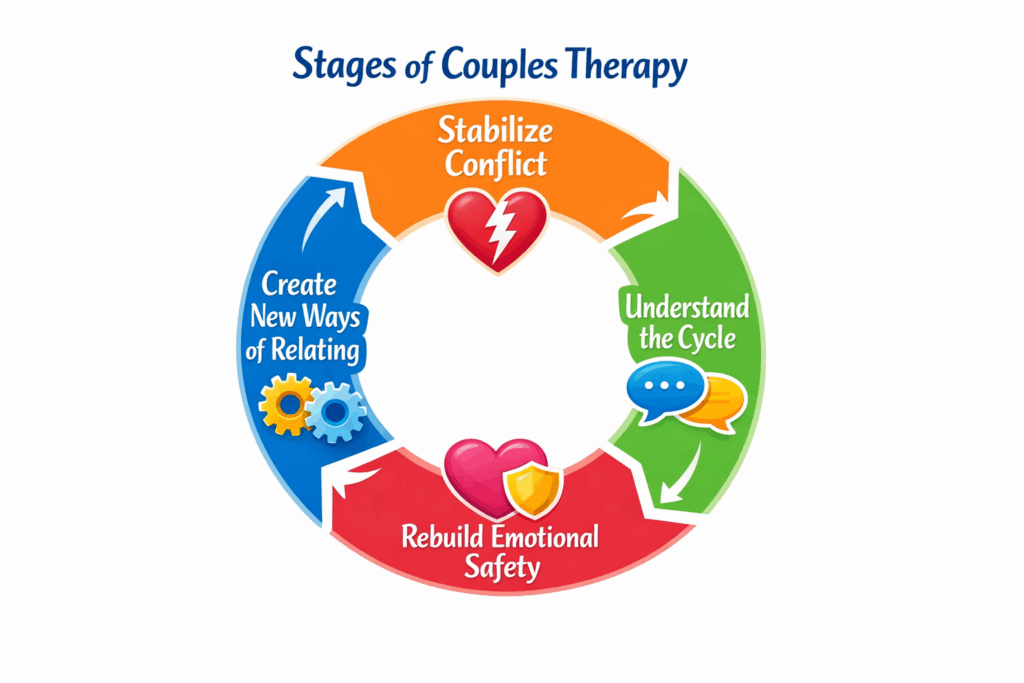
Every couple is different, but successful therapy often moves through recognisable phases:
Phase 1: Stabilise conflict
- Reduce escalation
- Set rules for safety (timeouts, respectful language)
- Stop the worst damage first
Phase 2: Understand the cycle
You learn the pattern underneath your fights:
- One partner pursues → the other withdraws
- Criticism → defensiveness → shutdown
- Fear disguised as anger
Phase 3: Rebuild emotional safety
- Honest conversations without collapse
- Empathy that feels real (not performative)
- Repair after conflict
Phase 4: Create new ways of relating
- Better conflict skills
- Clearer roles and boundaries
- Stronger friendship and intimacy
What progress looks like week to week
Progress often shows up as:
- Shorter fights
- Faster repair
- Fewer “days of distance” after conflict
- More warmth in everyday life
Discomfort can be part of growth because you’re changing patterns that once protected you.
Is Couples Therapy Worth It If You’re Unsure About Staying Together?
Yes, especially if the “unsure” feeling is mixed with grief, love, or confusion.
Therapy can help you:
- Understand what’s actually broken (pattern vs compatibility)
- Explore whether repair is possible
- Make decisions without using threats or panic
Success can sometimes mean finding clarity, other times it’s about reconciliation, or even a respectful parting. The key is that you no longer remain stuck in uncertainty.
What Makes Inner Voice Therapy Different for Couples
Inner Voice Therapy is built for couples who want:
- A warm, non-judgmental space
- Structure and direction
- Support that understands culture, family systems, and identity
- Evidence-informed work without clinical “speech”
The practice explicitly supports intercultural couples and recognises how family history and cultural pressure shape relationship patterns.
What to expect in your first couples session
At Inner Voice Therapy, couples’ sessions are commonly longer than individual sessions, often 60–90 minutes, to give both partners time and reduce rushed conversations.
In your first session, you can expect:
- A clear understanding of what brought you in
- How conflict typically starts and escalates
- What each partner needs to feel safe and heard
- Early tools to reduce harmful cycles
- A plan for what therapy will focus on (not just “talking about problems”)
If you’re not ready to commit yet, Inner Voice Therapy also offers a free 15-minute phone consultation (a short, friendly chat to discuss goals, fit, and logistics).
When to Consider Couples Therapy (A Simple Self-Check)
Consider couples therapy or relationship counselling if:
- You argue about the same things on repeat
- You feel emotionally alone in the relationship
- One or both of you avoid hard conversations
- Trust has been damaged
- Intimacy has dropped, and you don’t know how to fix it
- You still care, but don’t know how to reach each other
If there’s physical violence or ongoing coercive control, couples therapy is usually not the right starting point. Safety-focused support and individual resources are typically more appropriate.
Your Next Step
You don’t have to be in crisis to start. One good conversation guided safely can change the entire tone of a relationship.
If you’re in Mississauga and want support that understands culture, identity, and real relationship pressure, explore the Couples Therapy service at Inner Voice Therapy. (A free 15-minute phone consult is available if you want to start small.)
Frequently Asked Questions (FAQs)
Couples therapy is successful for 60–75% of couples, with many reporting improved communication, reduced conflict, and stronger emotional connections. Success is highest when therapy begins early and with the right approach.
Approximately 70–75% of couples experience improved relationships, with some deciding to stay together while others part ways respectfully. Therapy helps couples decide what’s best for their future.
Couples therapy sessions are typically held weekly, or you can choose to attend an intensive couples therapy retreat if you’re looking to address a specific issue. An intensive retreat involves 4-5 hours of therapy per day for two consecutive days.
Yes, couples therapy can be effective after infidelity. It helps rebuild trust, encourage accountability, and facilitate emotional repair, allowing couples to heal or make informed decisions about their future.